In response to exigencies of professional ethics, new technical standards, and new building regulations, CO2e emissions mitigation is becoming established as a central parameter of building performance. Rather than being an attribute of a specific class of buildings, environmental sustainability is becoming a required attribute of all buildings, positioned alongside structural integrity, safety, amenity, and other aspects of building performance as a necessary, verifiable metric of building design and construction. A contemporary challenge for architects is thus to integrate emissions mitigation strategies in ways that meet societal expectations and regulatory requirements while reinforcing good design and contributing to architectural meaning. Integration of environmental sustainability into meaningful design requires appreciation of the conceptual foundations underpinning these strategies and understanding of their cultural, industrial, and economic implications.
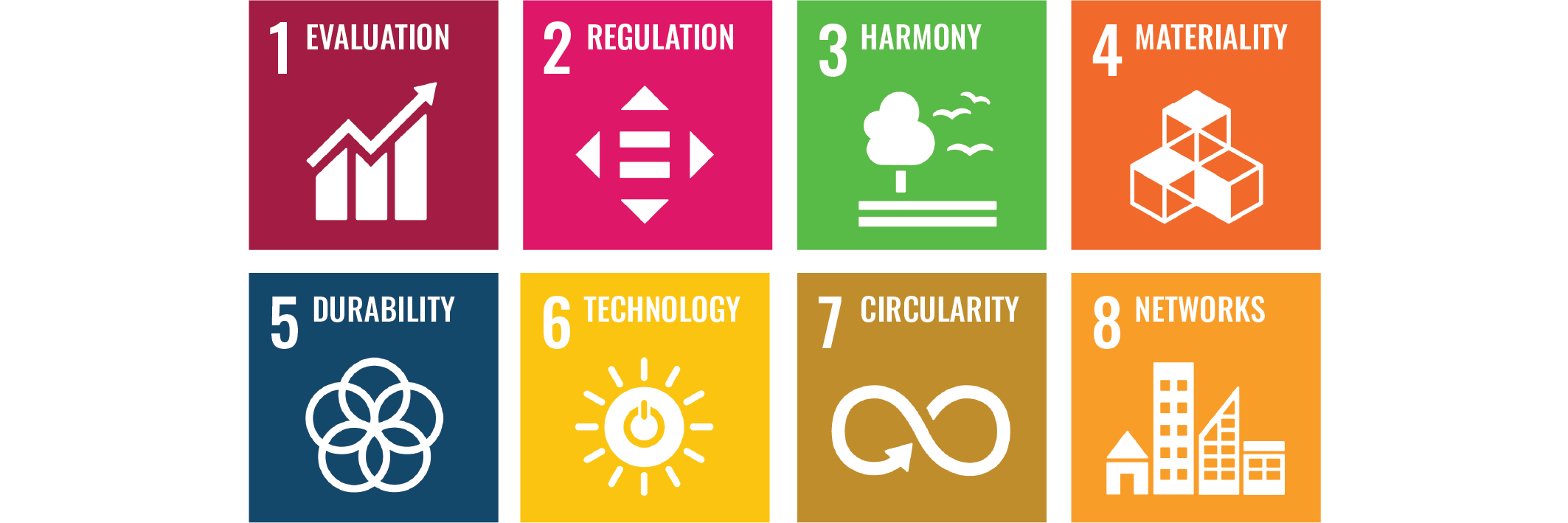
Dimensions of Building Sustainability contributes to the challenge of integrating sustainability into meaningful architecture by providing students with an overview of the current range of CO2e emissions mitigation strategies and techniques. The course addresses these strategies and techniques under eight dimensions: Evaluation, Regulation, Harmony, Materiality, Durability, Technology, Circularity, and Networks. Each week focusses on one dimension in sessions that explore foundational concepts, explain associated techniques, then use LCA to assess relative impacts of these techniques.
A few examples of how these dimensions are addressed in the course serve to illustrate the general approach:
Evaluation addresses different ways of defining and measuring building sustainability. The exploration of foundational concepts includes an overview of how the concept of sustainability has evolved historically, touching milestones such as the Silvicultura Economica of Hans Carl von Carlovitz (1713) which addressed the need to counter depletion of European forests, and the Brundtland Report published by the United Nations (1987), which introduced the three pillars of social, economic and environmental sustainability. A review of certification labels such as Minergie, SNBS, LEED, BREEAM, DNGB, and HQE identifies the wide range of differently-weighted criteria as indications of contemporary definitions and priorities. Explanation of measurement techniques includes a review of the processes and assessments required for Minergie and SNBS certification and an introduction to LCA as a framework for measuring embodied and operational CO2e emissions.
Durability encompasses strategies for extending the lifespan of buildings, including physical and functional durability. With regard to functional durability, concepts of use value versus exchange value inform discussion of building obsolescence and the economic, technological, and cultural factors that underpin decisions to renovate or demolish buildings. Explanation of associated techniques focusses on practical ways that the value of existing buildings is determined, including amortisement of taxable value, allocation of cultural value in heritage preservation rules, and assessment environmental value through calculation of amortised life-cycle emissions in accordance with SIA-2032 (2020). Relative assessment of emissions impacts of building renovation compared to demolition and reconstruction involves comparison of LCA case studies quantifying emissions in both scenarios, accounting for differences in embodied emissions arising from renovation versus new construction.
Technology encompasses technologies for improving energy performance – including envelope and energy systems – and renewable energy production. Foundational concepts reviewed include theories of technology such as Schumpeter’s creative destruction and the Solow-Swan growth model, as well as standard models of innovation adoption, comparing these with recent cases of technology development and diffusion. Associated techniques addressed include the current state-of-the-art in systems such as building-integrated photovoltaics (BIPV) and AI-assisted building control.
Each of the eight dimensions is treated in a similar manner, bringing together foundational concepts and practical techniques. LCA is used consistently throughout the course to compare emissions impacts. Teaching the use of the simplified LCA calculator provides students with skills and an accessible tool that can be used throughout the design process to rapidly and comparatively assess lifecycle emissions impacts of decisions about, for example, different materials and different building systems. Ultimately, the course is intended to provide students with knowledge and practical skills to support rigorous integration of relevant dimensions of building sustainability within their academic and professional work, and to provide analytical skills to critically evaluate and position their work within the broader field of environmental sustainability.
- Professeur-e: Ullal André